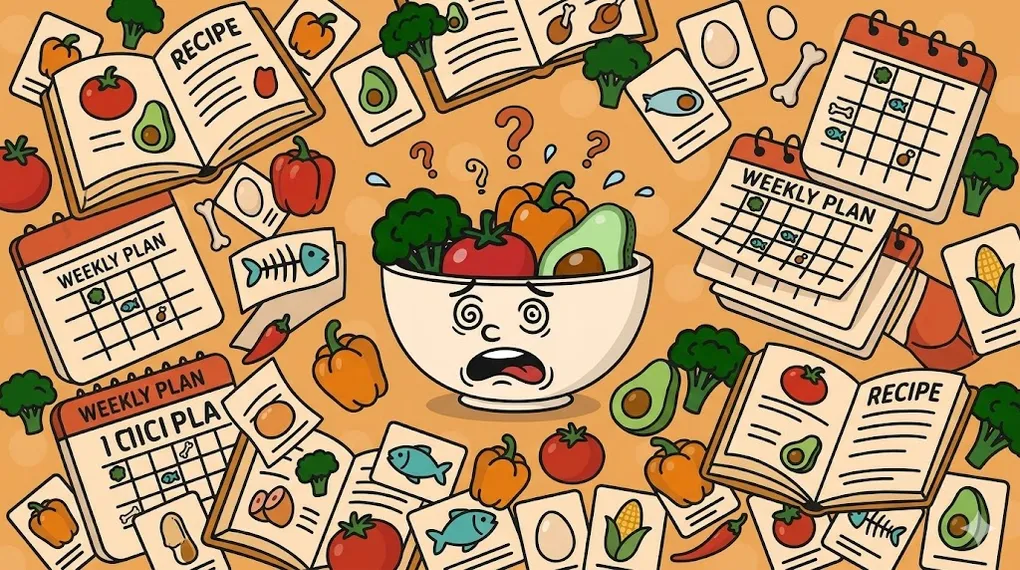
Why Meal Planning Feels Hard (And Why It Doesn't Have To)
Meal planning sounds like a good idea. In theory, you sit down on Sunday, sort out the week, and then just… execute. Less stress, less money wasted, better food. Everyone who does it swears by it.
So why do most people try it once, manage it for a week or two, and then quietly stop?
It’s not lack of discipline. The system itself is usually the problem.
The Version of Meal Planning That Doesn’t Work
The way most people attempt meal planning goes something like this: open a notes app or grab a piece of paper, try to think of five to seven dinner ideas from scratch, write a shopping list from memory, go to the supermarket, come home, and hope everything lines up when you actually get to cooking.
That’s a lot of mental work upfront. And it has to happen again next week, and the week after. If any part of the process is tedious — and most of it is — you’ll stop doing it the moment life gets busy.
Why It Falls Apart
It demands creativity at the wrong time. Planning meals requires you to think of ideas, remember what you have, anticipate what you’ll want to eat in four days, and coordinate across multiple recipes. That’s cognitively demanding work, and most people try to do it when they’re already tired.
The list is disconnected from the plan. You plan meals in one place, write a shopping list somewhere else, and hope you didn’t forget anything. When you inevitably do, mid-week cooking becomes frustrating and you start skipping the planned meals anyway.
It’s too rigid. Plans that require you to eat specific meals on specific days collapse the moment something changes — you stay late at work, you’re not in the mood for what’s planned, someone comes over. One disruption and the whole week feels off.
Starting from scratch every week is exhausting. If you have to reinvent the plan every Sunday, you’ll eventually run out of motivation to do it.
What Actually Makes It Stick
The people who meal plan consistently aren’t more disciplined — they’ve just made the system easier.
Keep a rotation, not a new plan every week. You don’t need seven brand-new meal ideas every week. A pool of fifteen to twenty meals you genuinely like, rotated through, is more than enough variety. Pick from the pool rather than generating fresh ideas from nothing.
Plan loosely, not rigidly. Assign meals to a week, not to specific days. That way if Tuesday’s plan moves to Thursday, nothing falls apart. The food still gets cooked, just not on a fixed schedule.
Make the barrier to starting as low as possible. The harder it is to sit down and plan, the easier it is to skip. If your recipes are organised, searchable, and ready to drop into a plan, the whole process takes minutes instead of half an hour.
Accept imperfect weeks. If you planned five meals and made three, that’s still three meals you didn’t have to decide on at 6pm when you were hungry and tired. A partial plan beats no plan.
The Role of the Right Tools
A lot of the friction in meal planning is friction that doesn’t need to exist. Searching for recipes across bookmarks, screenshots, and half-remembered ideas; manually writing out a shopping list; trying to remember what you’ve cooked recently — these are all problems a decent app solves.
Apps like Plateful are built around exactly this: keeping your recipes in one place, making it easy to plan the week, and keeping the whole process fast enough that you’ll actually do it every week rather than giving up after the second attempt.
The goal isn’t a perfect plan. It’s a simple enough system that planning becomes a ten-minute habit instead of a task you dread.
It’s Supposed to Make Life Easier
If your meal planning system is stressful, it’s the wrong system. The point is to remove decisions, not add them.
Start smaller than you think you need to. Plan three meals instead of seven. Use recipes you already know. Give yourself permission to swap things around. Build the habit first — the optimisation can come later.
Once it’s actually easy, you’ll keep doing it.